
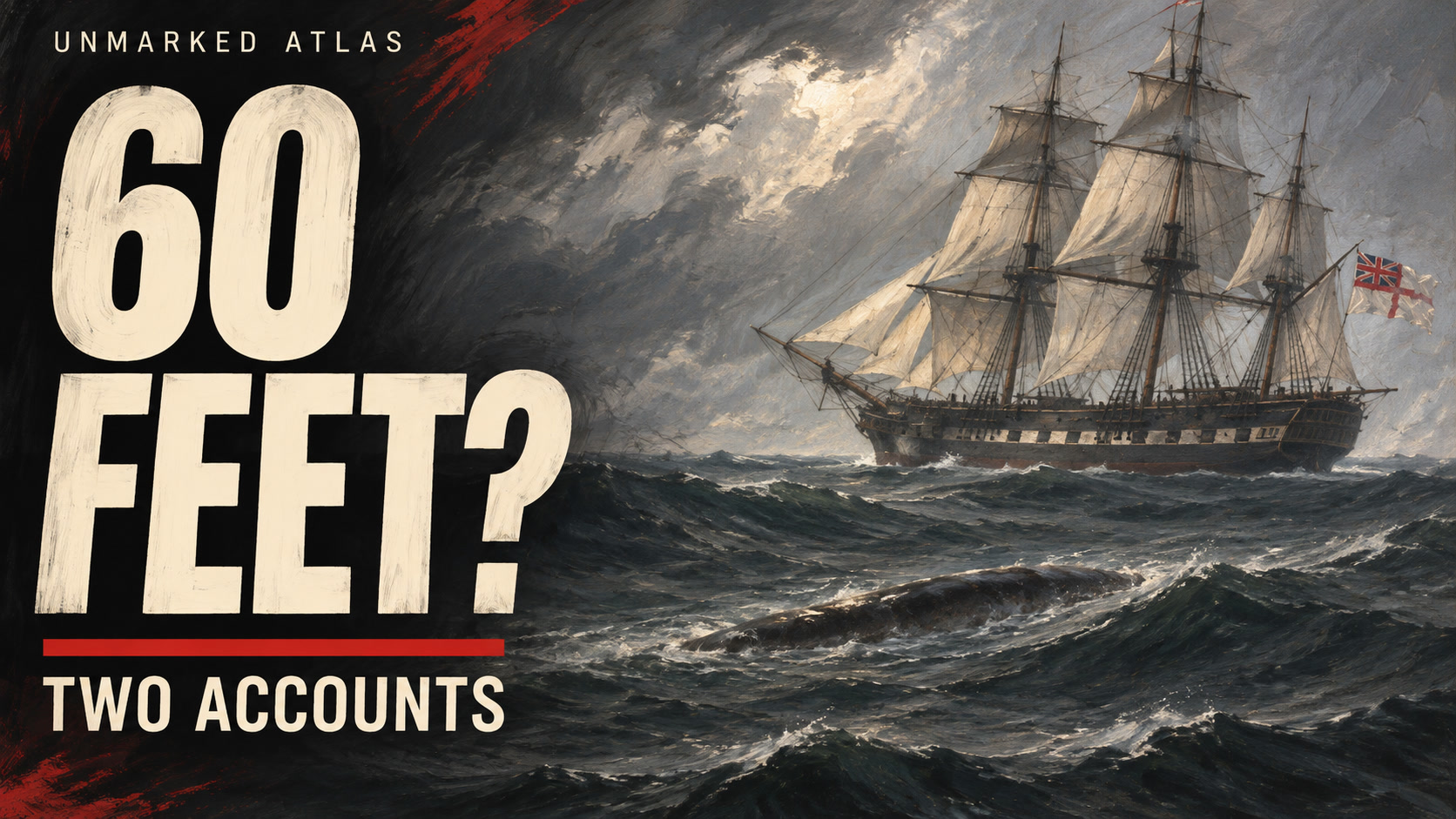
The captain’s account is confident. It is also an account we can read and compare with another officer’s description.
What the captain put in writing
In a letter dated October 11, the captain of HMS Daedalus described an encounter on August 6, 1848. He placed it in the South Atlantic, at 24°44′ south and 9°22′ east, in dark, cloudy weather with a long swell. [1]
He estimated at least sixty feet visible at the surface, comparing the length with the ship’s main topsail yard. He described no fins. Instead, he reported something resembling a mane or seaweed along the back. These are his descriptions and estimates, rather than measurements of a recovered animal. [1]
What Drummond described
The published extract attributed to Lieutenant Edgar Drummond describes a long, pointed head, flattened above, and a fin roughly twenty feet behind it. He estimated the closest distance at perhaps one hundred yards. [2]
That difference matters. Combining both reports into one detailed monster would erase the disagreement that makes the evidence interesting.
What we actually inspected
The captain’s letter was read in Gould’s 1886 printed reproduction. Drummond’s extract was read in a modern transcription, whose bibliography points to The Zoologist, volume 6, pages 2306–2307. We have not inspected the original diary manuscript. [1] [2]
The episode examines the reported encounter, the illustration and competing explanations. The documents establish a report worth investigating. They do not establish an unknown species.
A whale is a proposal, not a verdict.
In 2015, Gary Galbreath proposed a sei whale feeding at the surface. The idea offers an ordinary animal as an explanation for an extraordinary-looking encounter; it cannot bring the animal back for inspection. [2]
NOAA describes sei whales as roughly forty to sixty feet long and feeding by gulping or skimming. Those facts make the proposal worth considering. They do not make every detail of the reports agree. [3]
Watch, then read against the account.
The full episode, English captions and two self-contained Shorts are now available.
Watch the full investigation ↗Read the full episode transcript
Edited for readability; the video and its captions preserve the spoken delivery.
The captain said it was sixty feet long.
He put that in writing.
You have to respect a man willing to leave a paper trail.
It was August, eighteen forty-eight.
HMS Daedalus was in the South Atlantic when the thing passed the ship.
The captain saw a serpent.
Another officer described a fin.
The captain said there were no fins.
That is a problem.
It is also where the story gets good.
Read both accounts.
Keep the parts that agree.
Look hard at the parts that don't.
Something passed that ship.
We have their words.
Let's see how far those words take us.
Start with the weather.
Dark and cloudy.
A fresh wind out of the northwest.
A long swell coming from the southwest.
That is how the captain describes the afternoon of August sixth.
Five o'clock.
South Atlantic.
The letter gives coordinates.
It gives names.
A midshipman named Sartoris spots something unusual and reports it to the officer of the watch, Lieutenant Edgar Drummond.
The captain and the ship's master, William Barrett, are walking the quarterdeck with him.
The crew, the captain says, are at supper.
The thing comes toward them from ahead and to the side.
It passes near the back of the ship, on the side sheltered from the wind, and carries on southwest.
The captain says it never changes course.
That's the whole encounter, really.
Something comes toward the ship.
The men watch it go by.
Everything else depends on how well they could see it, and what they made of the parts above the water.
The captain describes a head and shoulders held about four feet above the sea.
Behind them, at least sixty feet of the animal lies visible at the surface.
That is his estimate.
Sixty feet is an excellent number for a story.
It is large enough to be alarming and exact enough to sound measured.
So ask how he got it.
He compared what he saw with the length of the ship's main topsail yard.
He used something familiar to judge something unfamiliar.
A reasonable thing to try.
Still an estimate.
And there is a harder question underneath it.
Sixty feet of what?
How much is head?
How much is back?
Where does the animal end and the disturbed water begin?
Those are questions the account invites.
We cannot settle them by making the drawing more convincing.
The captain puts its speed at twelve to fifteen miles an hour.
He can't see it wriggling from side to side, or moving up and down to push itself through the water.
An enormous thing, going somewhere, without any obvious effort.
Whatever's moving it is out of sight.
He can see it moving.
He can't see how.
Then the captain makes a remarkable comparison.
Had the object been a man he knew, he says, he could have recognized his features with the naked eye.
He wants the reader to understand how close it was.
He is very sure of himself.
Hold on to that.
Drummond is going to give us a distance.
The captain says it's dark brown, with a yellowish-white throat.
Just behind the head, he puts it at fifteen or sixteen inches across.
To him, the head looks unmistakably like a snake's.
Then there's something on its back.
He says it looks like a horse's mane, or a bunch of seaweed washing around.
No fins.
He's clear about that.
He says they can keep watching through their telescopes for twenty minutes.
Other men saw it too, according to the letter: the quartermaster, the boatswain's mate, and the man at the wheel.
We have the captain saying they were there.
We don't have each man telling us what he saw.
There's no attack in this account.
The thing passes the ship and keeps going.
That's unsettling enough.
You're standing on a deck, watching something you can't explain, and it seems to have somewhere else to be.
Now look at the date on the letter.
October eleventh.
The sighting was August sixth.
More than two months have passed by the time he writes this report.
And we know why he's writing.
A story has appeared in the Times.
The Admiralty wants him to explain it.
The story is already in the newspaper when the Navy asks for this account.
The copy we're reading was printed in eighteen eighty-six, in a book called Mythical Monsters by Charles Gould.
He reprinted the captain's letter.
So we're looking at a later copy of an older report.
The paper trail is interesting enough without changing what kind of paper it is.
Near the end of the letter, the captain mentions a sketch made right after the sighting.
He's having a drawing made from it to send to the Admiralty.
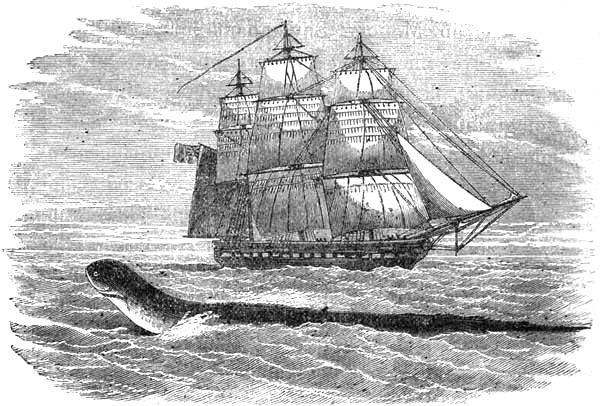
Gould's book includes a picture of the encounter, copied from the Illustrated London News.
Now there's a face to look at.
A body.
A creature beside a ship.
You can read a description and still struggle to picture the thing.
Then you see a drawing, and suddenly you know what it looked like.
Or you feel as if you do.
But someone had to decide where every line went.
A drawing can show you what the story describes.
It can't prove the story got the shape right.
For that, we'd want the witnesses to agree.
And this is where Drummond becomes a problem.
In the published extract from Drummond's diary, the head is long and pointed, with a flat top.
And about twenty feet behind it, he sees a fin.
He mentions a tail, or another fin, farther back.
But he's careful about that part.
The captain said he saw it.
Drummond doesn't claim that he did.
At its closest, he puts the thing perhaps a hundred yards away.
He says they could see it with the naked eye for about five minutes, then through a telescope for perhaps fifteen more.
He's estimating too.
But now we have a distance to think about.
We're reading that eighteen forty-eight extract as it's reproduced in a modern article.
We haven't seen the original diary.
That's how this version reaches us.
Now put the two accounts next to each other.
The captain says there are no fins.
Drummond sees a fin on its back.
The captain says the head stays above the surface.
Drummond says it briefly disappears beneath the waves.
The captain says it was close enough that he could have recognized a familiar face.
Drummond says perhaps a hundred yards.
That doesn't mean somebody made the whole thing up.
It means two men watching the same thing didn't describe it quite the same way.
If we pick our favorite details from each account and put them together, we've written a third account.
Neither man gave us that one.
They do agree on an unusual shape moving steadily through the sea, dark above and paler below.
The captain is certain it's a serpent.
Read both accounts, though, and the shape gets harder to pin down.
In twenty fifteen, researcher Gary Galbreath proposed a sei whale feeding at the surface.
In that explanation, what looked like a raised head was part of an open mouth.
Most of the whale was underwater.
It's an explanation built from the accounts, long after the animal was gone.
Sei whales can be forty to sixty feet long, according to NOAA Fisheries.
They feed by gulping water or skimming food from it.
So a whale is worth a serious look.
That doesn't mean every detail fits.
And we can't bring this particular animal back for a better look.
But it gives us another possibility.
Could an ordinary animal, seen from an unfamiliar angle, have looked like something extraordinary?
I believe the captain was sure.
You can hear it in the letter.
But being sure doesn't let us see what was under the water.
Here's what we actually have.
We have the captain's published report, a later copy of it, and the published diary extract.
Those accounts tell us what the men thought they could see: the shape, the colors, the movement, and how big and how far away it seemed.
Then we have the explanations.
The captain's serpent.
Drummond's different description.
The whale proposed much later.
The reports, the observations, and the explanations are three different things.
A naval officer reported a sea serpent.
That much is in the record.
Saying the Navy proved a monster existed would take us further than these sources can.
With HMS Daedalus, we have a date, a position, names, and a detailed report.
We also have two officers who disagree about what was sticking out of the water.
The captain deserves a hearing.
So does Drummond.
The disagreement is part of the story.
For a little while, something passed that ship and kept going southwest.
Then came the letters, the sketches, and the explanations.
We're still looking at those.
The men on the quarterdeck got to look at the thing itself.
And even they left us different pictures.
We haven't established an unknown species.
We have a strange encounter, taken seriously by the men who described it, and enough detail to keep asking questions.
This is Unmarked Atlas.
Military encounters.
Government mysteries.
Worldwide.
Read the sources
- Charles Gould, Mythical Monsters (1886), pp. 292–293 and Fig. 70
Later reproduction of the captain’s report. The illustration is a historical representation of the account.
- Gary J. Galbreath (2015), The 1848 “Enormous Serpent” of the Daedalus Identified
Access copy for the attributed Drummond extract; original journal and diary not directly inspected.
- NOAA Fisheries: Sei whale
Species information used to assess the later whale proposal.